
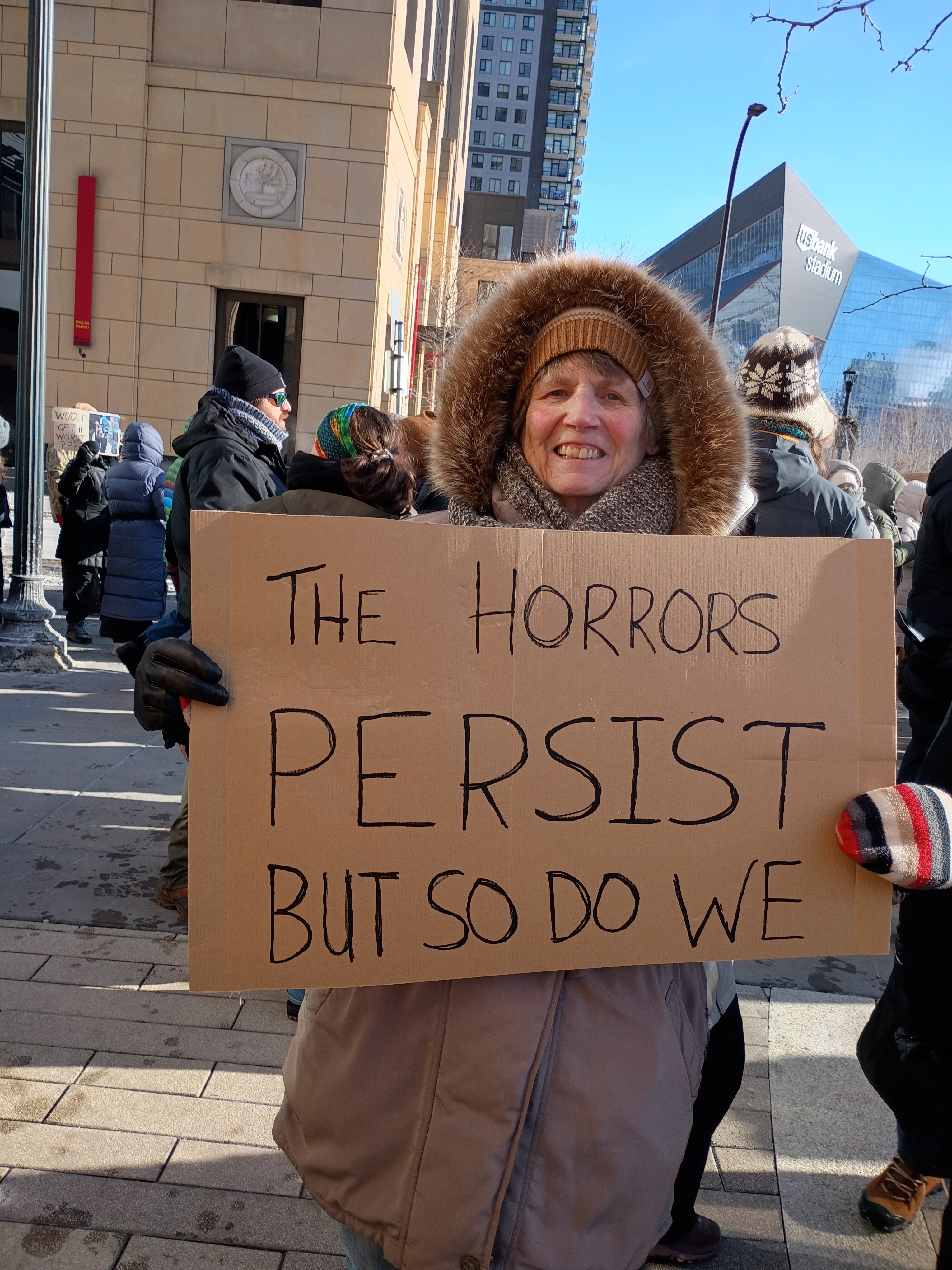
Lord knows, Minneapolis is not perfect. Anyone who has driven down our streets, swerving around crater-sized potholes, or past trash-filled homeless encampments can tell you that. Our city council often seems more interested in renaming lakes or squabbling than in solving real-life problems. However, I was never prouder of my city than this past couple of months, when we were invaded by ICE goons, who were sent here by a vindictive federal government fixated on punishing blue states and cities, because they didn’t vote for the current president.
We were outraged when these so-called law enforcement officers, paid with our tax dollars, invaded our city, breaking the law and violating our rights. Heavily armed, masked thugs swarmed our streets, harassing, arresting, and in two cases, killing our fellow citizens. The residents of Minneapolis did not cower in their homes, as the feds apparently expected.
They didn’t realize that, along with hotdish, neighborliness is in our DNA. You can’t survive frigid winters up here on the tundra without a little help. We might not be the chattiest people, limiting our usual neighborliness to nodding and waving, but if your car gets stuck in the snow, people in parkas will emerge from surrounding houses and help push you out of the snow.
Tens of thousands of us took to the streets to protest. In sub-zero degree weather, I joined an estimated 50,000 others in the marches downtown after the killing of Renee Good. And then, even more people, upwards of 100,000, marched again after the killing of Alex Pretti. Additional tens of thousands of citizens quietly organized to deliver food to people frightened into sheltering in place, and to escort people to and from school, work, and more.
In addition to marching, I joined a class, Faith & Immigration Justice, offered by my church, Our Lady of Peace, to learn more about immigration history and law. One of the textbooks, Welcoming the Stranger, by Matthew Soerens and Jenny Yang, is especially eye-opening.
I learned that there weren’t any immigration laws before the late 1880s. So, when many of our immigrant ancestors, including mine, came, they faced no legal barriers. The ocean crossing was daunting, but once here, they were able to quickly get off the boat and begin their new lives. My ancestors on my father’s side came from Ireland in the 1840s to escape starvation. My mother’s ancestors came from Bohemia in the 1880s to take advantage of free land available as homesteads in northern Minnesota.
These immigrants joined other family members who arrived before them. In the case of the Bohemians, they formed an ethnic community where it took a generation or two to learn the new language and fully integrate into the larger society. My mother, a second-generation American, spoke Czech at home. She learned English at school. In spite of this, she became a teacher. Immigrants are often ambitious people.
Today’s immigrants are the same as our immigrant ancestors. They come here for a better life, to escape hunger, poverty, and political instability, and rejoin their families. Only, they cannot easily immigrate. There are a myriad of laws, restrictions, and fees making it difficult, often impossible, for people to immigrate for the reasons our own ancestors camehere, to seek a better life. (See chapter four, “Immigrating the Legal Way,” in Welcoming the Stranger, for more information.) And yet, they are desperately needed in a variety of occupations. Industries such as farming, manufacturing, construction, healthcare, restaurants, and more wouldn’t be able to get along without their labor. So, the promise of available jobs beckons to those struggling to make ends meet, just south of the border. What would you do for your family if you were in their place?
What we really need is comprehensive immigration law reform, the likes of which has not been enacted for many decades. Instead, politicians prefer to score political points by making out that the immigrants are the problem. They are not. The system is the problem.
“If this is going to be a Christian nation that doesn’t help the poor, either we have to pretend that Jesus was just as selfish as we are, or we’ve got to acknowledge that He commanded us to love the poor and serve the needy without condition and then admit that we just don’t want to do it.” ― Stephen Colbert
 Bonnie's Books & Things
Leave a comment